
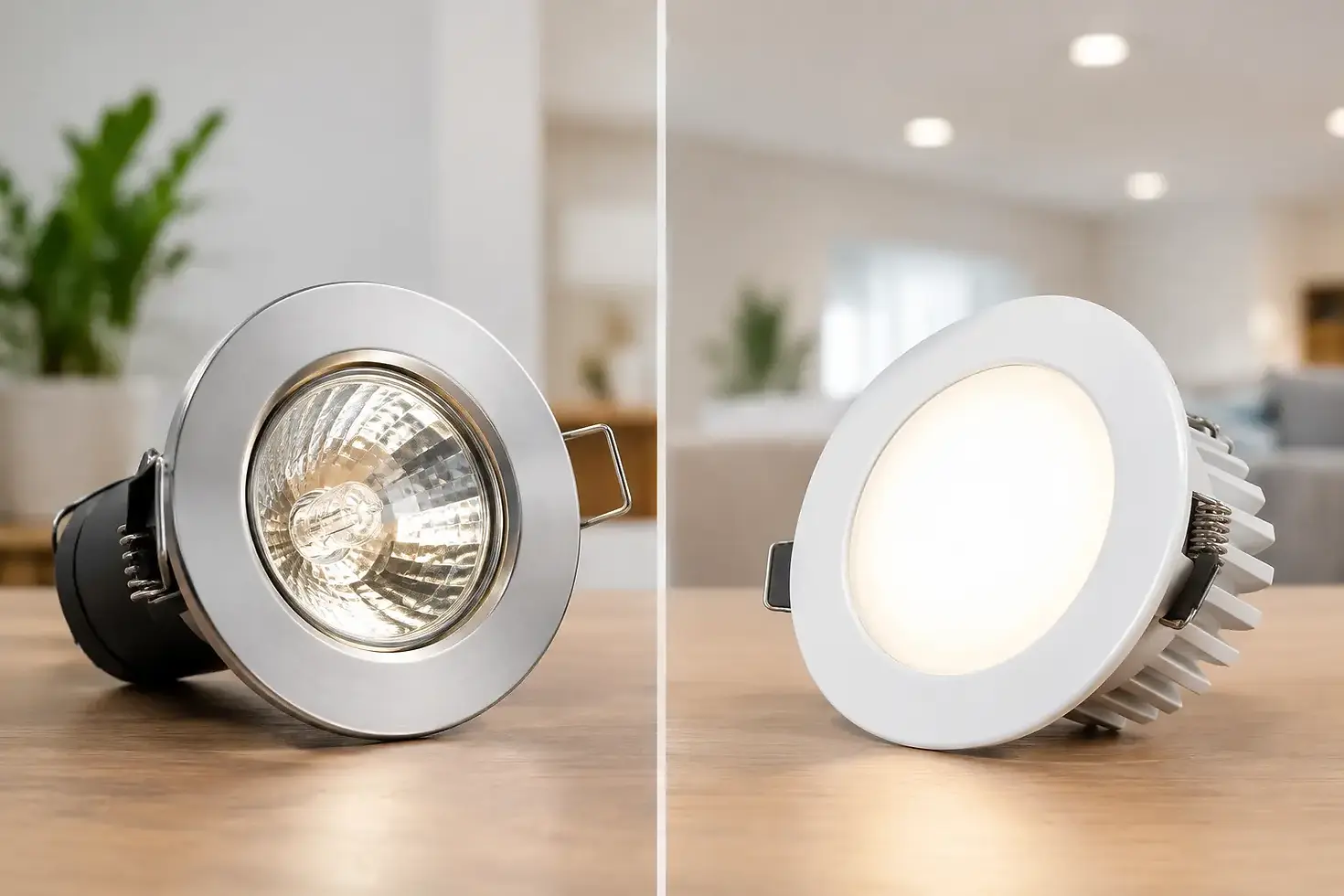
Halogen Versus LED Downlights: Which Suits?

A ceiling full of halogen downlights can make a room look great, but it can also make the power bill and ceiling space work harder than they need to. For homeowners, landlords and business owners weighing up halogen versus LED downlights, the decision is usually about more than changing a globe. It involves running costs, heat, light quality, fittings, transformers and a safe, compliant installation.
LED downlights are now the practical choice for most new installations and many upgrades. That does not mean every halogen fitting should be swapped without inspection. The right approach depends on the existing wiring, fitting type, ceiling insulation and how the space is used.
Halogen versus LED downlights: the key differences
Halogen downlights produce light by heating a filament. They have long been valued for their bright, crisp light and good colour rendering, particularly in kitchens, retail areas and feature lighting. The drawback is that much of the energy they use becomes heat rather than useful light.
LED downlights use light-emitting diodes and considerably less energy to produce a similar level of illumination. A typical 50-watt halogen globe may be replaced by an LED option using around 5 to 10 watts, depending on the required output and product selected. Across a home with multiple downlights, or a commercial tenancy where lights operate for long hours, that difference adds up.
The comparison is not simply watts versus watts. Light output is measured in lumens, so an electrician should select LED fittings based on the illumination needed for the room, rather than assuming a lower-wattage fitting will automatically deliver the same result. Beam angle, ceiling height, wall colours and task areas all affect how bright a space feels.
Running cost and lifespan
The clearest advantage of LEDs is lower electricity use. If downlights are switched on every evening, an LED upgrade can reduce the lighting component of a household or business electricity bill substantially. The more lights installed and the longer they run, the stronger the case becomes.
LEDs also generally last far longer than halogen globes. Fewer globe changes are convenient in any home, but they are particularly useful in high ceilings, rental properties and commercial premises where maintenance takes time and can disrupt occupants or trading.
Lifespan figures should still be treated sensibly. An LED fitting may not achieve its stated life if it is installed in excessive heat, paired with an incompatible dimmer or driver, or supplied with poor-quality power. Product quality and correct installation matter just as much as the technology.
Heat and ceiling safety
Halogen downlights run hot. That heat can build up in the ceiling cavity and requires appropriate clearances from combustible materials, including insulation. It can also contribute to heat entering living areas during a Perth summer, when air conditioning is already working hard.
LED downlights operate at a much lower temperature, but they do not produce no heat. Their electronic components still need to shed heat properly. A fitting must be suitable for its location and installed in accordance with the manufacturer's instructions, particularly where ceiling insulation is present or likely to be added later.
This is one reason an LED upgrade deserves more attention than a quick globe change. An electrician can inspect the ceiling space, identify whether existing fittings have suitable clearances, and select products with the appropriate insulation rating. It is a practical safety check, not an optional extra.
Light quality is no longer a reason to stay with halogen
Early LEDs earned a poor reputation for harsh, blue-tinged light and uneven output. Modern quality LED downlights offer a broad range of colour temperatures and colour-rendering performance, making it much easier to create comfortable, useful lighting.
Warm white light, commonly around 2700K to 3000K, suits living rooms, bedrooms and hospitality-style spaces where a softer feel is preferred. Neutral white, often around 4000K, is popular for kitchens, laundries, offices and work areas because it provides a clearer appearance. Cooler colour temperatures can suit specific task or commercial applications, but may feel clinical in a home if overused.
Colour rendering is worth considering where accurate colour matters. This includes kitchens, bathrooms, retail displays, artwork and areas used for makeup or detailed work. A high-quality LED with strong colour rendering can provide natural-looking results without the energy demand of halogen lighting.
Beam spread matters too. Narrow beams can create pools of light and dramatic highlights. Wider beams give more even general illumination. Replacing every existing halogen with an LED of the same shape and expecting identical results can leave darker patches or excessive glare. The layout should be assessed as a complete lighting plan.
Can halogen downlights be changed directly to LED?
Sometimes, but not always. Older halogen downlights commonly use a low-voltage transformer. Some LED replacement globes will work with an existing transformer, while others may flicker, fail to dim correctly or not switch on at all. The transformer may also require a minimum electrical load that a low-wattage LED globe cannot meet.
In those cases, the appropriate solution may be replacing the transformer, installing an integrated LED fitting, or updating the circuit arrangement. Integrated LED downlights combine the light source and fitting in one unit. They can provide a neat, efficient result, although the fitting rather than just a globe is replaced at end of life.
Dimmers need the same care. A dimmer designed for halogen loads may not perform reliably with LEDs. Symptoms include flickering, buzzing, a limited dimming range or lights remaining faintly illuminated when switched off. A compatible LED dimmer and correctly matched fittings usually resolve these issues.
Electrical work involving fixed wiring, transformers, switches or fittings should be completed by a licensed electrical contractor. In Western Australia, this protects both the installation and the people relying on it.
When keeping halogen may be reasonable
There are limited situations where retaining halogen temporarily can be sensible. A rarely used feature light, a specialist fitting where an LED alternative does not provide the required beam pattern, or a property approaching a broader renovation may not justify an immediate full replacement.
Even then, check the condition of the fittings and the heat clearance in the ceiling. Halogen systems with aged transformers, brittle wiring, discoloured fittings or repeated globe failures should be inspected rather than repeatedly patched.
For most frequently used downlights, especially in kitchens, living areas, offices, shops and common areas, LED is generally the better long-term option. It offers lower operating costs, less heat and reduced maintenance without requiring a compromise on usable light.
Plan the upgrade around the room, not just the fitting
A considered upgrade starts with how each room is used. A kitchen may need brighter task lighting over benches, while a lounge may benefit from warm, dimmable general light. Bathrooms require fittings appropriate for their location and exposure to moisture. In a commercial setting, lighting must support staff comfort, visibility and the purpose of the space.
It is also a good opportunity to review switch locations, dimming requirements and exterior lighting. Replacing fittings one-for-one may be appropriate, but a small change to layout can improve a dark hallway, reduce glare at a desk or make a living area more comfortable at night.
For properties in Byford, Armadale, Kelmscott and surrounding areas, a licensed electrician can assess existing halogen downlights before recommending a replacement method. Burrows & Co. Electrics provides owner-led electrical service with attention to safety, compliance and practical energy-saving outcomes.
The best lighting upgrade is the one that delivers the right amount of light, runs efficiently and is installed correctly for the ceiling it sits in. Before buying a box of replacement globes, have the existing fittings checked and choose a solution that will remain safe and useful for years to come.


Comments